The reported measurement
Start with the label beside the number
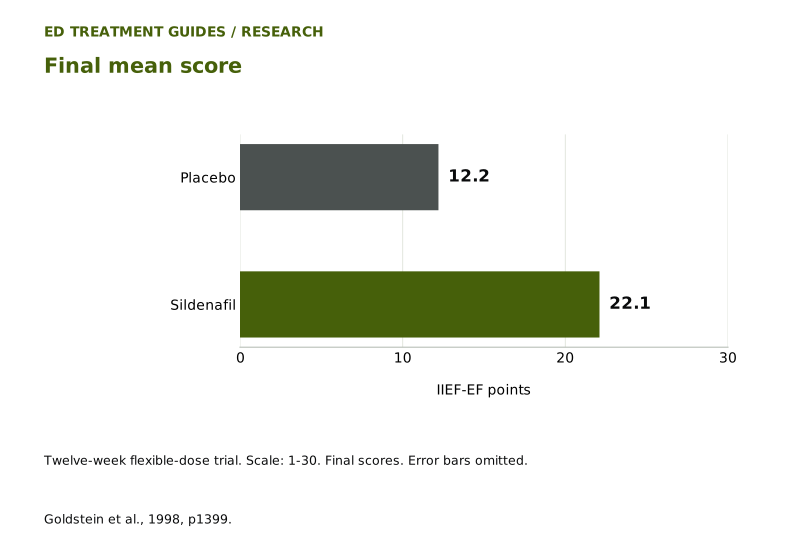
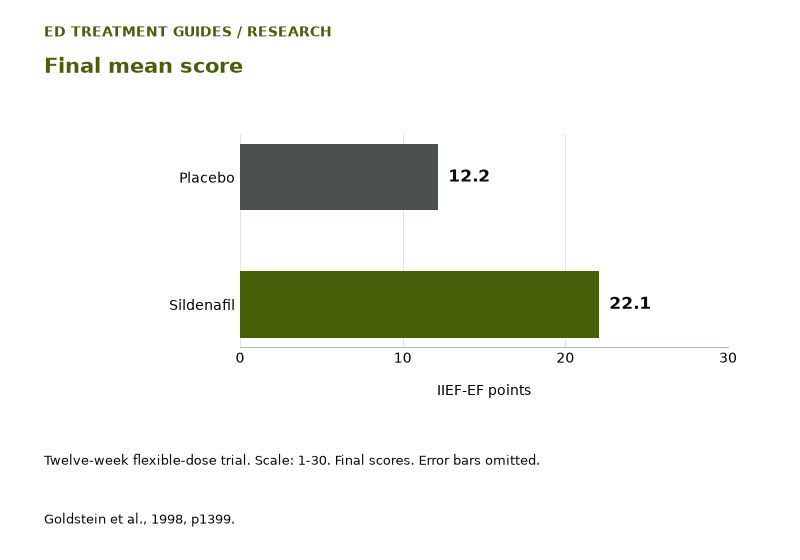
In randomized, blinded treatment of men with ED, placebo and oral sildenafil produced final mean IIEF erectile-function scores of 12.2 and 22.1, respectively. IIEF names the International Index of Erectile Function.
The first interpretive task is dimensional: ask what kind of thing could be added, averaged or compared. A questionnaire score summarizes responses under a scoring rule. Treating any score as a percentage merely because it appears on a chart would introduce a denominator that the scoring rule has not supplied. The size of the scale alone cannot establish a probability, and dividing by its upper bound does not turn it into a chance of success.
The next task is to separate measurement from importance. An instrument can record a difference without telling a reader how a particular person would value it. Establishing that link would require an appropriate interpretation of the instrument and the clinical setting. Our sildenafil treatment guide provides a separate route into treatment questions; the present reading exercise begins with the narrower question of what a numerical summary actually says.
Sources: 1
An arrival point does not describe the journey
Consider a fictional exercise with an invented zero-to-eighty task scale. In one imaginary group the average starts at eighteen and ends at thirty-four. Another begins at twenty-nine and also finishes at thirty-four. Their final averages match, but their changes do not: sixteen points in the first group and five in the second. These made-up numbers illustrate an arithmetic distinction, not a treatment threshold or a model of erectile function.
A final score locates an arrival point. A change score adds information about the departure point. Neither automatically supplies the best comparison for every research question. If groups begin in different places, a study may account for baseline measurements in its analysis. Reading only the bars cannot reconstruct that analysis, because the necessary relationships among measurements may be missing.
Notice how the wording changes the claim. Saying that two groups ended together describes the endpoint. Saying that one group improved more describes movement. Saying that treatment caused the difference requires a design and analysis capable of supporting a causal interpretation. Moving among those sentences without checking the evidence quietly changes the question.
Sources: 1
Why a concurrent comparison carries information
Imagine evaluating a course by surveying participants only after they take it. A favorable response might reflect the course, expectations, who enrolled, or other changes during the same period. Adding a comparison group observed over the same period helps distinguish an intervention from influences shared by both groups. This thought experiment concerns research structure, not an explanation established for any particular drug result.
Random assignment is useful because assignment should not systematically follow a participant characteristic that also predicts the outcome. It does not make every characteristic identical in a finite sample. Blinding addresses a different problem: knowing the assignment may affect behavior or reporting. Neither feature replaces checking how the outcome was measured, how missing observations were handled, or which comparison the analysis actually tested.
A reader can therefore ask three separate questions: how were groups formed, what could participants and investigators know, and what information entered the analysis? Those questions give a controlled comparison its meaning. A before-and-after story lacks the same structure, even when its improvement sounds striking. The value of the comparator is the alternative explanation it helps examine, not simply the presence of another colored bar.
Sources: 1
The same average can hide different experiences
Here is a second fictional exercise on the same invented task scale. One imaginary set contains sixteen, thirty-two and forty-eight; another contains thirty-one, thirty-two and thirty-three. Both average thirty-two. The first is widely spread, while the second is tightly clustered. Neither arrangement is a reconstruction of a trial, and no value has a clinical interpretation.
A mean compresses several observations into one location. That compression is useful for describing groups, but it removes the pattern of individual values. Without a distribution, a reader cannot identify how many people were near the average, whether there were distinct clusters, or whether an unusual value influenced the summary. The average need not describe a typical experience in the ordinary conversational sense.
The table keeps the arithmetic and inference separate. An average can support a question about a group while leaving a personal forecasting question unanswered. Recovering the latter would require information about variation and relevant individual characteristics, followed by evidence that the resulting prediction works. More decimal places in the average cannot replace those missing steps.
| Imaginary observations | Mean | What the mean hides |
|---|---|---|
| 16, 32, 48 | 32 | Wide separation |
| 31, 32, 33 | 32 | Tight clustering |
| Two matching means | No distribution implied | Different patterns remain possible |
Sources: 1
Follow the observations into the analysis
A research report can contain several legitimate counts: people approached, people assigned, people receiving treatment, and people contributing a particular measurement. These counts describe different stages. Before using any count as a denominator, connect it to the outcome being discussed. A total on a recruitment diagram is not automatically the total underlying every subsequent statistic.
Missing observations create a question about what is unknown. In an imaginary survey, people who stop responding might have improved, worsened, become busy or lost interest. The direction of a possible bias cannot be established merely from the fact that a response is missing. An analysis must make its handling of absent information explicit; a reader should then consider whether alternative assumptions could change the conclusion.
Terms describing an analysis population are starting points for inspection rather than substitutes for it. Ask how the authors define inclusion in that population and whether the rule is applied to the selected endpoint. This is especially useful when a paper presents several instruments or several stages of follow-up. Following the observations prevents a broad participant total from acquiring a precision or completeness it has not earned.
Sources: 1
Separate visible distance from statistical precision
Two bars can be far apart on a screen because the underlying values differ, because the vertical axis is narrow, or both. Reading the axis first guards against a visual impression becoming a numerical conclusion. Then inspect what the graphic says about uncertainty. The appearance of a clean boundary around a bar does not mean that its estimate is known without sampling variation.
A confidence interval describes an estimate under a statistical procedure and its assumptions. It is not the range in which every participant must fall. A measure of individual spread answers another question. Confusing those two uses of variation can make a group result look more personally predictive than it is. A figure without an interval does not authorize a reader to supply one from intuition.
Likewise, subtracting two displayed averages is an arithmetic operation, not necessarily a reconstruction of the study analysis. Adjustment, correlation, missing measurements and the analysis population can matter to that analysis. This article does not manufacture an adjusted contrast or an interval from the figure. The productive question is what additional reported information would make such a calculation justified, rather than how many calculations the visible numbers permit.
Sources: 1
Compare questions before comparing treatments
Suppose two unrelated investigations each show a favorable numerical result. Before ranking their interventions, compare the questions: the populations, comparator, measurement, observation period and analysis. Even when two axes use points, the underlying instruments may differ. When one uses a score and another a proportion, a direct ranking needs still more justification. A familiar drug name does not make the surrounding research designs interchangeable.
The companion article on reading daily tadalafil evidence approaches a different measurement problem. Read it as another exercise in defining a quantity. Placing two articles beside each other is not an indirect trial, and a larger printed number in one article does not create a treatment hierarchy.
A useful comparison table should preserve those distinctions instead of erasing them. The questions below are an editorial reading aid, not extracted study findings. They identify the information needed before attempting a cross-study conclusion. If several answers remain unknown, the comparison may be useful for planning further reading while still being insufficient for a claim of superiority. That intermediate position is more informative than either forcing a ranking or dismissing the evidence entirely.
| Check | Information needed | Mistake prevented |
|---|---|---|
| Measurement | Definition and unit | Ranking unlike quantities |
| Population | Eligibility and clinical setting | Assuming equal applicability |
| Time | Measurement schedule | Equating different follow-up periods |
| Analysis | Comparator and uncertainty | Treating two summaries as a direct trial |
Use current safety information for current care
Current Viagra labeling contraindicates nitrates/nitrites and guanylate cyclase stimulators such as riociguat. It calls for cardiovascular, medication, kidney and liver assessment; combining ED therapies is not recommended. Listed adverse reactions include headache, flushing and indigestion. An erection lasting over four hours requires immediate help. Sudden vision loss or hearing decrease/loss requires stopping the medicine and prompt care. Chest pain, dizziness or nausea during sex requires stopping activity and immediate medical help.
These are present-day safety statements, not adverse-event rates reconstructed from the historical figure. The PDE5 safety guide is a separate starting point for organizing the discussion with a clinician. Safety and benefit require different kinds of questions: what was measured for a group, what hazards apply to the proposed medicine, and what features of the person matter for its use.
Keeping those questions distinct improves interpretation. A favorable efficacy summary cannot function as a safety screen, and a warning does not tell us the size of an efficacy effect. A coherent clinical discussion needs both kinds of information without allowing one to stand in for the other.
Sources: 3
Ask whether the evidence matches the finished product
FDA states that compounded medicines are not approved by the agency and do not receive its premarket review for safety, effectiveness or quality. They can address an individual medical need. Our evidence-matching interpretation is narrower: ingredient research alone does not establish a particular finished preparation’s performance.
A useful documentary exercise is to write the product description beside the study description, then identify the questions left open. What formulation is being discussed? What evidence concerns that formulation? What claim is actually being made? The brand and generic comparison can help organize further reading, while the Hims review and Ro review provide places to inspect documented service terms. Those links are not assertions about access to a studied product or expected outcomes.
This separation also applies to commercial presentation. A nearby promotional speed ranking is not a research conclusion established by the figure. As editorial reasoning, we suggest recording the evidence for a clinical claim separately from information about ordering, payment or support. A convenient purchase process and a well-supported treatment claim answer different questions; neither proves the other.
Turn the reading into a precise follow-up question
A useful reading note contains three short entries: the quantity measured, the conclusion the comparison supports, and the information still needed for your next question. This format makes disagreement easier to examine. Two readers may agree about the arithmetic while disagreeing about how much personal relevance it has. Naming the missing link is more productive than arguing over whether the result is simply good or bad.
For a fictional example, a reader might write: I understand the group summary, but I want to know whether the measurement captures the change that matters to me. That is a request to connect an instrument with a goal, not a demand that a published average become a promise. Another reader might ask what evidence addresses a different clinical setting. Both questions remain specific enough to guide further reading.
Our first ninety days guide and guide to discussing an unsatisfactory response offer separate care-oriented reading. The editorial lesson here is to bring a clearly defined question to that conversation. A research summary becomes more useful when its boundaries help identify the next piece of information, rather than when every uncertainty is compressed into a yes-or-no verdict.
Editorial assessment
A disciplined reading starts by naming the quantity, preserves the comparison that gives it meaning, and asks what additional evidence would support the next inference. The most useful conclusion may therefore be a well-formed question rather than a treatment ranking. The fictional exercises demonstrate why that restraint is substantive: an average, a change and a personal prediction contain different information, even when casual language treats them as equivalent.
Evidence limits
Pfizer grants, company involvement and consultant relationships. Complete paper retained October 23, 2026; reread October 24. Renewed access blocked; no protocol, supplements or individual data reviewed. Current labels and FDA material were checked October 24. No clinician review is claimed.
Frequently asked questions
Does dividing a questionnaire score by its maximum create a success rate?
Why use made-up examples when real results are available?
Can a group comparison tell me which individual improved?
Is a missing confidence interval the same as a negative result?
What should a provider review contribute to this reading?
What this is based on
We link to primary sources — clinical guidelines, regulator publications and peer-reviewed research — wherever possible. Links open on third-party sites we do not control.
- [01]Original primary paper. Goldstein et al. (1998): oral sildenafil trial.Checked 2026-10-24. Full paper (public exhibit).
- [02]Original primary paper. Porst et al. (2006): daily tadalafil trial.Checked 2026-10-24. Full paper (public exhibit).
- [03]Current prescribing information. VIAGRA (sildenafil citrate) US prescribing information.Checked 2026-10-24.
- [04]Current prescribing information. Cialis (tadalafil) prescribing information.Checked 2026-10-24.
- [05]FDA public information. Understanding the risks of compounded drugs.Checked 2026-10-24.